Product links on this page go to Amazon. If you buy through them, Your First Espresso earns a commission. How we pick and earn
An espresso machine dies two ways: scale in the heater and rancid coffee oil in the group. Both are cheap to prevent and expensive to fix. Here is the routine, from the makers’ manuals.
Scale
Hard water is water with dissolved minerals; heat it and some of them stay behind as scale. Breville’s manual lists what it does: mineral build-up “reducing the brewing flow, brewing temperature, power of the machine, and the taste of the espresso”. A thermoblock’s narrow passages block first.
What water to use
Filtered or softer water helps, as Fellow’s guide says, and then the line everyone needs: never use distilled water in your espresso machine. Pure water has nothing to extract with and the makers’ sensors and boilers expect some minerals. The simplest answer on hard water is distilled or reverse-osmosis water with a mineral packet made for espresso machines: known hardness, low scaling, every time. Breville’s machines take a tank filter, which Breville says to remove before descaling. The De’Longhi manual asks you to set the water hardness from a test strip so the descaling alarm comes at the right interval, and says its filter lasts about two months.
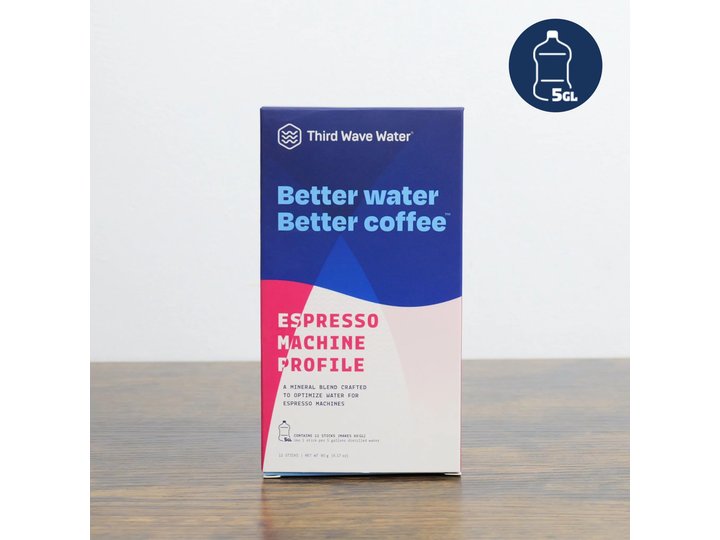
Mineral packets for distilled water
Third Wave Water, espresso profile
Third Wave Water Espresso Machine Profile, 5-gallon sticks
Mineral sticks you dissolve in a gallon of distilled or reverse-osmosis water to make espresso water with known hardness and no scale-forming surprises: the water problem solved for a few cents a litre.
- Form
- Mineral packets, each for 5 gallons (listing)
- Base water
- Distilled or RO
- Profile
- Espresso machine (lower scaling)
Suits: Anyone on hard tap water, or who has already descaled once and didn't enjoy it.
Weigh: Needs distilled or RO water as the base; distilled on its own is wrong for the machine, as Fellow's guide says. The maker's site blocks readers; specs are the listing's.
Cleaning is not descaling
Two different jobs. Cleaning removes coffee oil from the group, the shower screen and the valve; it is a backflush with a detergent. Descaling dissolves mineral deposits from the heater and pipes; it is a tank of descaling solution run through. Breville’s manual says plainly that its cleaning cycle “is separate from descaling”.
Cleaning
The Breville machines count shots and, per the manual, prompt a cleaning cycle after 200: a tablet in the cleaning disc that comes in the box, run the cycle, done. The Gaggia and Silvia have a three-way valve and take a classic backflush: a spoon of cleaning powder in a blind basket, run the pump in bursts, rinse. The Stilosa and Dedica have no three-way valve and can’t be backflushed; wipe the screen and run water through.
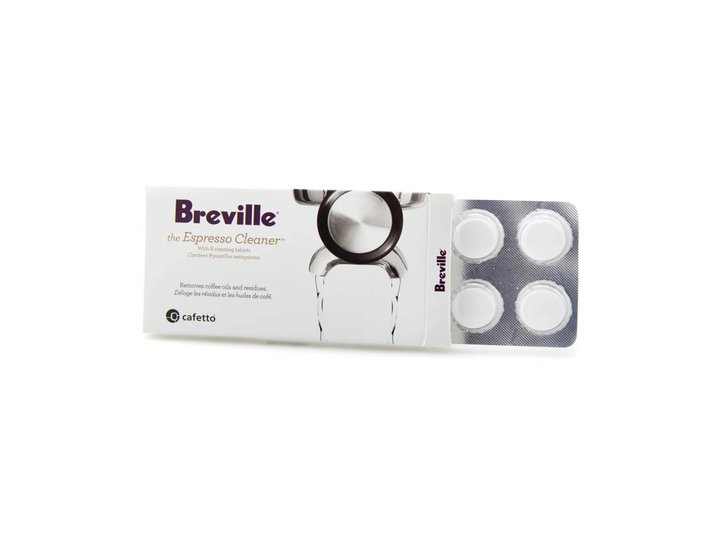
Cleaning tablets for the Breville cleaning cycle
Breville cleaning tablets, 8-pack
Breville BEC250
The tablet Breville's machines ask for: one in the cleaning disc, run the cycle the machine prompts after 200 shots, and the group and valve are clear of coffee oil.
- Count
- 8 tablets (listing)
- Use
- Cleaning cycle with the included disc; the Bambino Plus prompts after 200 shots
Suits: Every Bambino, Barista Express and Barista Pro.
Weigh: Cleaning is separate from descaling; this does not remove scale. Breville's product page for the tablets isn't findable, so the count is the listing's.
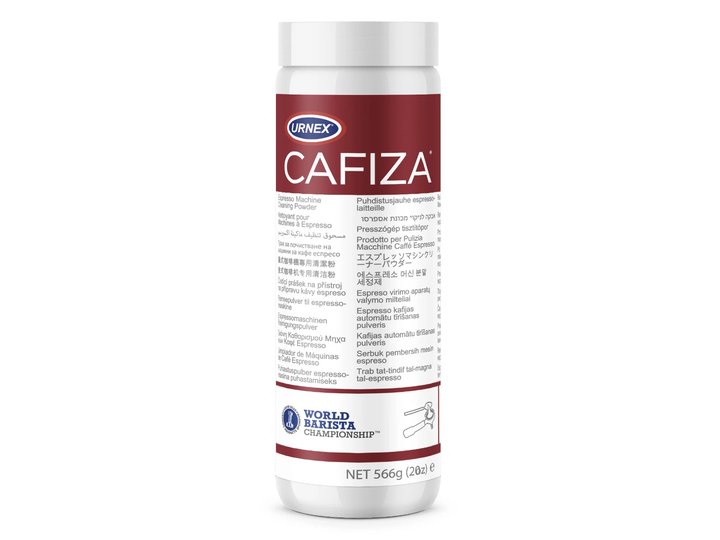
Backflush cleaning powder
Urnex Cafiza espresso machine cleaner
Urnex Cafiza powder, 566 g
The café-standard cleaning powder: a spoonful in a blind basket, backflushed through the group, dissolves the coffee oils that make a machine taste stale. A tub lasts a home machine years.
- Form
- Powder, 566 g (listing)
- Use
- Backflush with a blind basket
Suits: Gaggia and Rancilio owners with a three-way valve; Breville owners use the included cleaning disc and tablets.
Weigh: Backflushing needs a machine with a three-way solenoid valve (Gaggia, Rancilio, Breville with its disc); the Stilosa and Dedica can't be backflushed. Specs are the listing's.
Descaling
When the machine asks (Breville’s lights, De’Longhi’s orange lamp), not on a calendar, because the interval depends on your water and how much you pull. Use the maker’s descaler or a citric-acid product sold for espresso machines; never vinegar in a thermoblock. Remove the tank filter first. Good water pushes the interval out to months or years.
The daily minute
- Wipe and purge the steam wand after every use. Immediately.
- Knock the puck out and rinse the basket; a knock box makes this a two-second habit.
- Flush the group for a second to clear the screen.
- Empty the drip tray when the float shows.
- Weekly: soak the portafilter and basket in cleaning solution; wipe the shower screen.
Beans
Coffee oil goes rancid in the grinder too. Keep beans in a sealed, dark canister and buy what you’ll drink in a few weeks; Breville’s manual treats 30 days off roast as the line where a pressurized basket takes over.
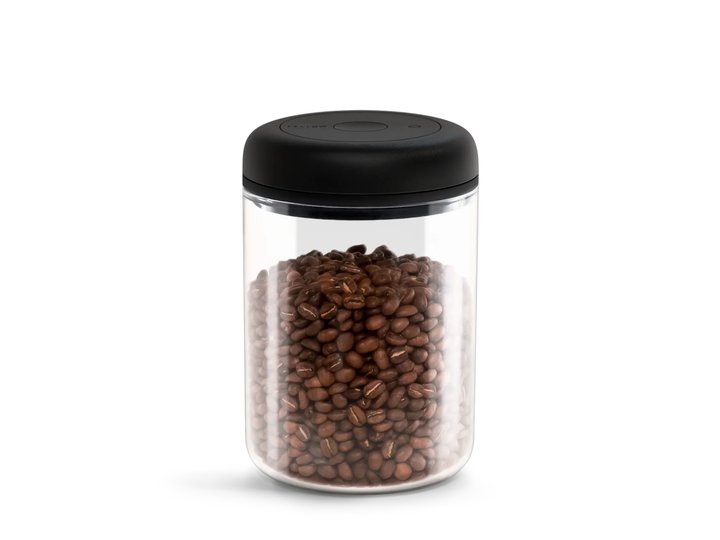
Vacuum bean canister, 11 oz of beans
Fellow Atmos vacuum canister, 0.7 L
Fellow Atmos 0.7 L
A canister whose lid pumps the air out when you twist it, keeping a bag's worth of beans fresh for the two or three weeks it takes to drink them.
- Capacity
- 0.7 L; about 11 oz of beans
- Seal
- Twist-to-vacuum lid; re-twist every 4–5 days
- Material
- 301 18/8 stainless
Suits: Anyone buying beans by the bag rather than the pound; single-dose grinders with no hopper.
Weigh: Fellow says to re-twist every four or five days, and not to put it in the dishwasher. Holds about 11 oz; a 12 oz bag doesn't quite fit.
Every product above is on the tools and care page.