Product links on this page go to Amazon. If you buy through them, Your First Espresso earns a commission. How we pick and earn
“Dialing in” is finding the grind setting that makes a given coffee taste right on your machine. It takes two or three shots once you know the method. Here is the method, with the numbers from the makers’ own guides.
The recipe
Fellow’s guide: start with 18 g of ground coffee, aim for about 36 g of espresso, a 1:2 ratio, in roughly 25 to 35 seconds. Breville’s: 18–22 g is a safe start, 1:2 for a standard espresso (1:1 ristretto, 1:3 lungo), ideally 25 to 30 seconds and acceptable between 20 and 40. Breville’s manual adds the smaller numbers for its 54 mm baskets: 8–11 g in the one-cup, 16–19 g in the two-cup.
So, for the first shot: 18 g in, stop at 36 g out, and look at the clock. You need a scale with a timer under the cup; without one you’re guessing twice.
What the time tells you
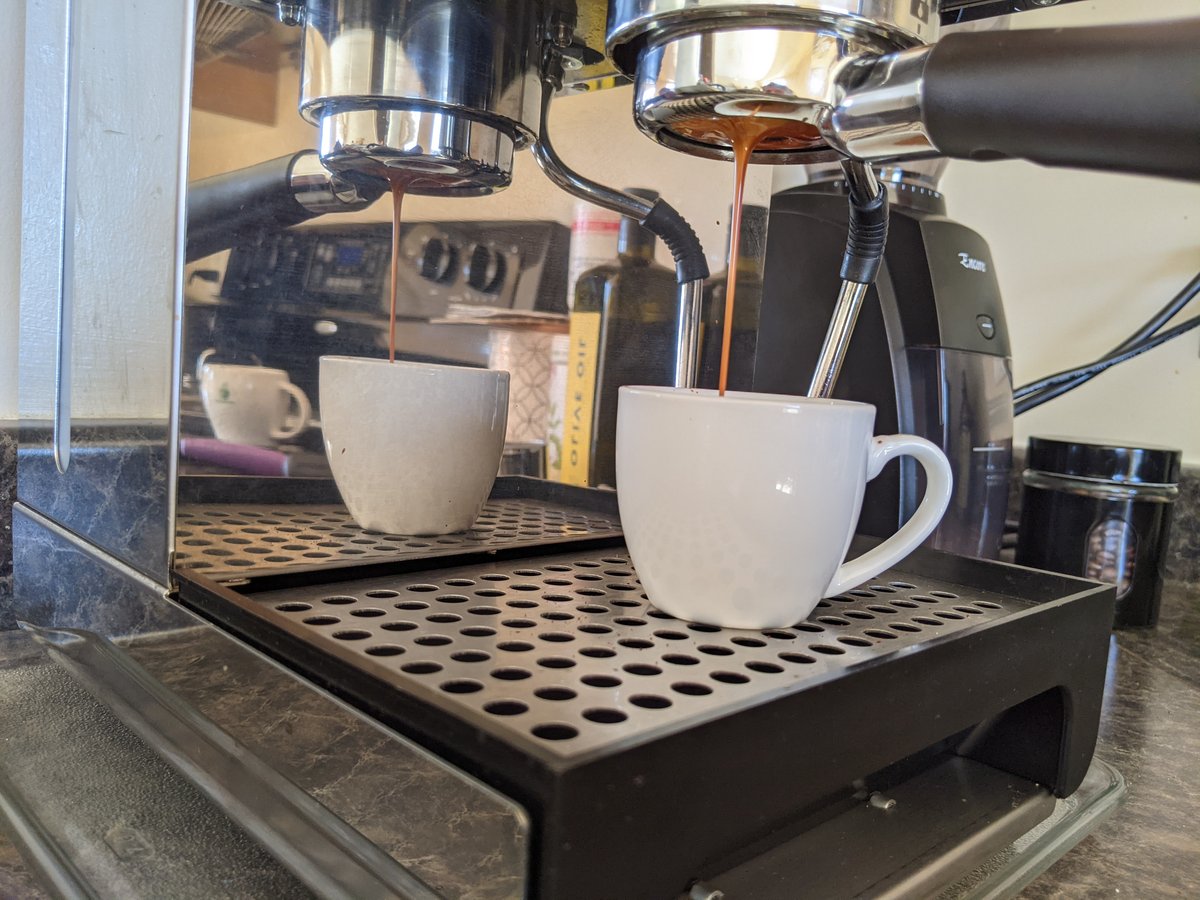
Grind size controls how fast water gets through, and the time is the readout:
- Under 20 seconds, pale, thin, sour: the grind is too coarse. Water rushed through. Go finer.
- Over 35 seconds, dark, bitter, drips: too fine. Water struggled. Go coarser.
- 25 to 30 seconds, caramel-coloured, sweet and a little sharp: leave it.
Breville’s manual gives the same rule from the other end: if the first drips arrive in under 7 seconds the grind is too coarse; if nothing flows after 12 seconds, too fine. Change one thing per shot, and change the grind, not the dose, until the time is right.
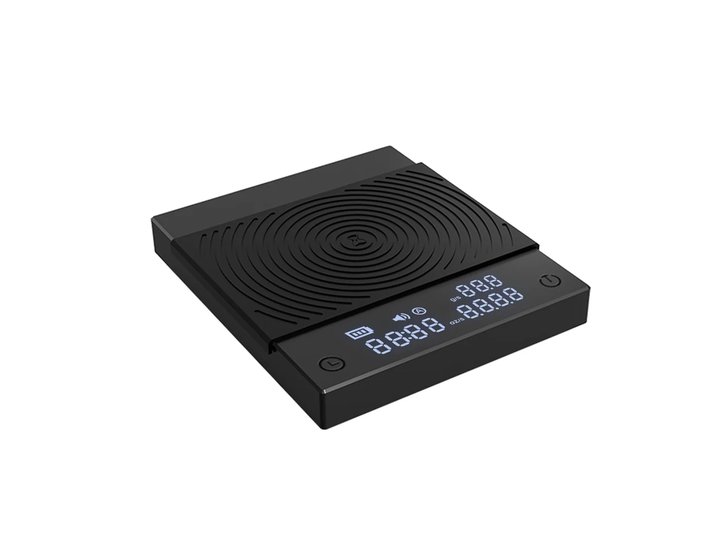
0.1 g scale with auto timer and flow rate
Timemore Black Mirror Basic 2
Timemore Black Mirror Basic 2
The espresso scale: 0.1 g resolution, a timer that starts when the first drop lands, flow-rate display, USB-C charging, and a footprint that sits under most drip trays.
- Range
- 2 kg, 0.1 g (0.5 g minimum)
- Timer
- Auto start; flow rate
- Battery
- 1,600 mAh USB, about 10 h
- Size
- 152 × 130 × 26 mm; 380 g (listing)
Suits: Every setup. The scale is what makes "18 in, 36 out" a recipe instead of a guess.
Weigh: At 26 mm thick it is tight under the Dedica and Bambino trays; measure. Amazon claims 24 hours of battery; Timemore says about 10.
Taste, in two words
Sour is under-extraction: fast shots, coarse grind, not enough taken from the coffee. Bitter is over-extraction: slow shots, fine grind, too much. A shot that is both is an uneven grind or a channel in the puck, which is the grinder’s problem or your prep. Most beginners read sour as “weak” and add coffee, which makes it worse; go finer instead.
Prep: the same every time
The recipe only works if everything but the grind is held constant:
- Weigh the dose in. Use a funnel so it all lands in the basket.
- Stir the clumps out with a WDT tool and level the bed.
- Tamp level, the same pressure every time. Breville’s manual says 22–33 lb and that consistency matters more than the number; a spring tamper makes that automatic.
- Lock in, start the scale, pull.
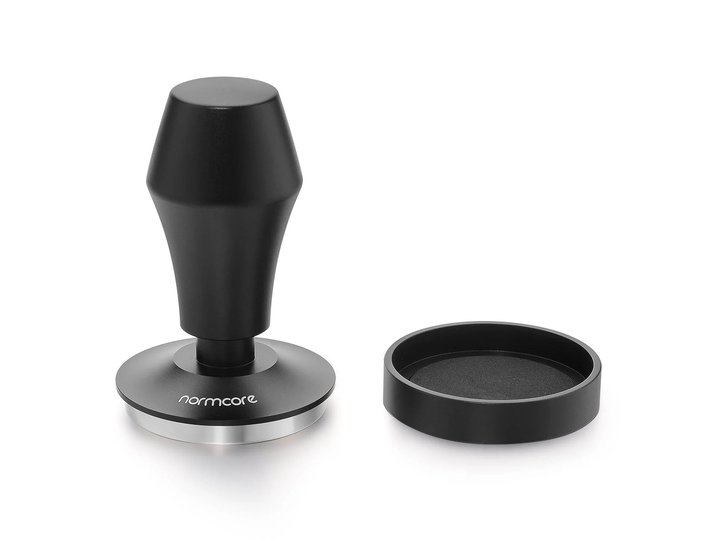
Calibrated tamper for Breville 54 mm baskets
Normcore spring-loaded tamper, 53.3 mm
Normcore V4, 53.3 mm
A spring-loaded tamper that clicks at a set pressure, so every tamp is the same: 25 lb installed, 15 and 30 lb springs in the box, sized at 53.3 mm to fit Breville's 54 mm baskets.
- Size
- 53.3 mm, for 54 mm baskets (Breville, Sage)
- Springs
- 15 / 25 (installed) / 30 lb
- Other sizes
- 51 mm (De'Longhi), 58 mm (Gaggia, E61)
Suits: Every Breville owner; the single biggest fix for inconsistent shots after the grinder.
Weigh: This is the Breville size. De'Longhi machines take the 51 mm, Gaggia and Rancilio the 58 mm, each a separate listing. Breville's own tamper is fine too, it just doesn't click.
Pre-infusion, briefly
Breville’s machines wet the puck at low pressure for several seconds before going to 9 bar; Breville describes about 3 bar for about 7 seconds. It lets the puck swell evenly before the pressure arrives, and it’s why your first drips take a few seconds. The Gaggia and Silvia have none; their shots start faster and reward careful prep.
When the beans change
Every new bag needs re-dialing: a different roast, a different age, a different grind. Start where the last bag ended and expect one or two shots to land it. Beans in their first week off roast gas more and run faster; Breville’s manual draws the line at 30 days, after which it points you at the dual-wall basket.
Then milk: steaming for a latte.