Beginner espresso machines: entry single-boilers, a lever and two travel presses
Every machine here heats water and pushes it through coffee at about nine bar. What separates them is how steadily they hold temperature, whether the baskets in the box are the real kind, what the steam wand can do, and whether a grinder is bolted on. Twelve machines, from a six-inch thermoblock to a brass single boiler, and three that need no plug.
What the words mean
Four spec-sheet terms decide what a machine can do. Baskets get their own guide.
Thermoblock, thermocoil, boiler
Heater
A thermoblock or Breville's ThermoJet heats water on the way through: ready in seconds, steady enough with a PID. A boiler holds hot water: slower to heat, stronger steam, and the design that takes a PID well.
PID or a light
Temperature control
A PID holds the brew water at a set temperature; Breville claims ±2 °C. Without one you wait for a light and time the shot off it. Every Breville here has PID; the Gaggia, Silvia and De'Longhis don't.
Single wall or dual wall
Baskets
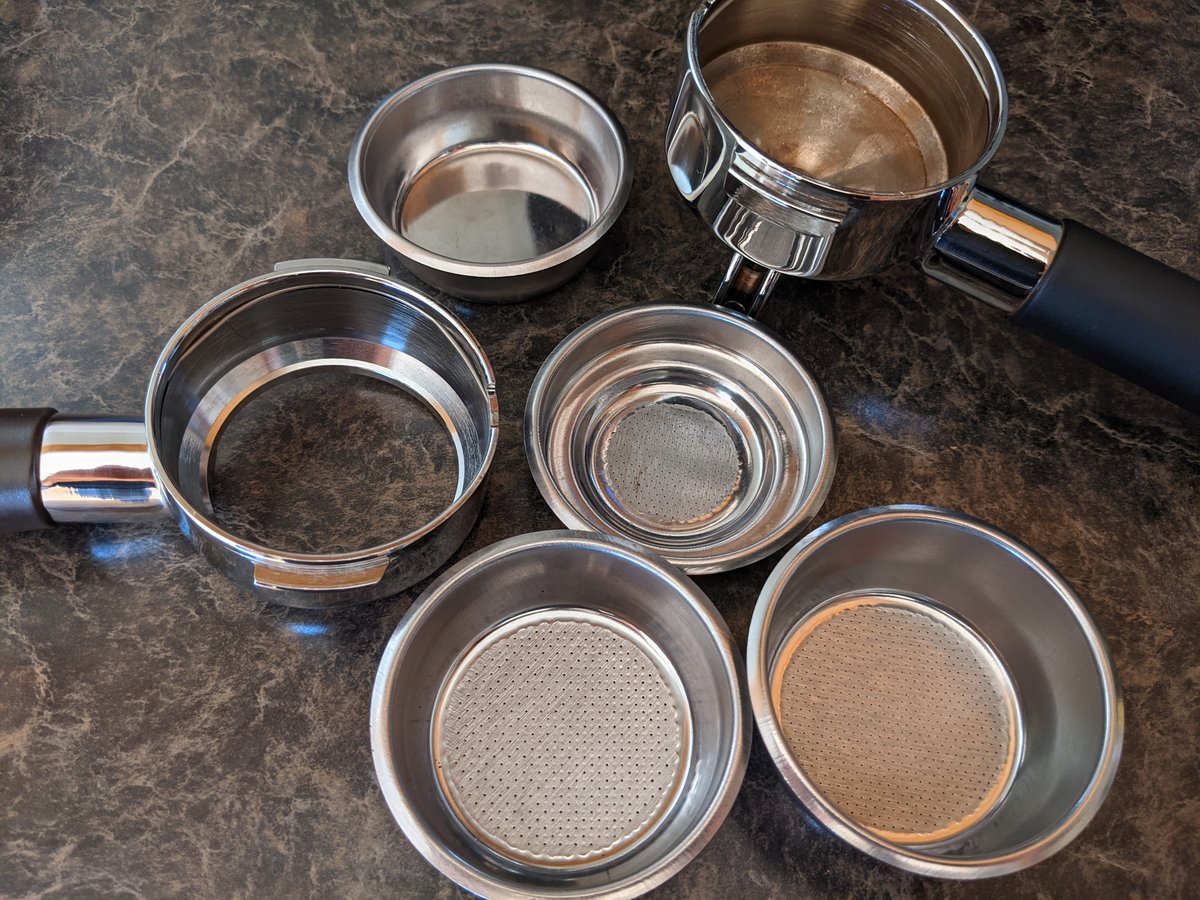
A single-wall (non-pressurized) basket makes espresso the real way and needs a real grinder. A dual-wall (pressurized) basket fakes the resistance and works with pre-ground. Breville ships both; De'Longhi ships pressurized only.
Manual, automatic, none
Steam
A manual wand makes microfoam when you learn it. An automatic wand (Bambino Plus) does it for you. The lever and travel presses have none; a frother fills in.
Quick picks
The short answer for common situations. Each links to the full card below.
A non-pressurized 52 mm basket you pump by hand; café shots on a campsite.
Compare the twelve
Heater, baskets, steam and tank from each maker's page or manual. De'Longhi doesn't publish the Dedica's basket diameter, Rancilio doesn't publish the Silvia's; the listings say 51 and 58 mm. Every pump here is rated 15 bar; Breville and Gaggia state a 9 bar extraction limit, De'Longhi doesn't.
Product links on this page go to Amazon. If you buy through them, Your First Espresso earns a commission. How we pick and earn
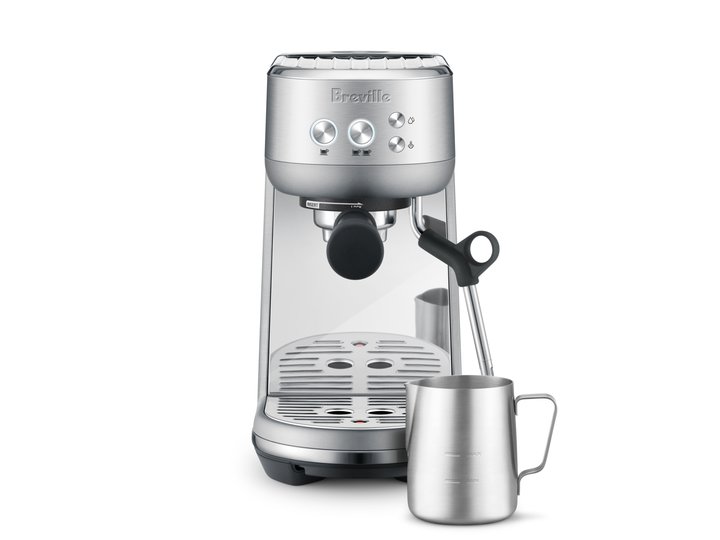
The small machine that changed the entry level: hot in three seconds, PID temperature control, low-pressure pre-infusion then 9 bar, single-wall and dual-wall 54 mm baskets in the box, and a manual steam wand that makes real microfoam.
Heater
ThermoJet, ready in 3 s
Temperature
PID
Pressure
15 bar pump; low-pressure pre-infusion, 9 bar extraction
Baskets
54 mm; 1 and 2 cup, single wall and dual wall
Steam
Manual wand
Tank
47 fl oz
Size
11.9 × 6.1 × 13.5 in; 10.42 lb; 1,560 W
Warranty
1 year
Suits: A small kitchen and a separate grinder. The machine most of this site assumes.
Weigh: Light, plastic-bodied, a tiny drip tray and no pressure gauge. No grinder; that is the point, and the budget.
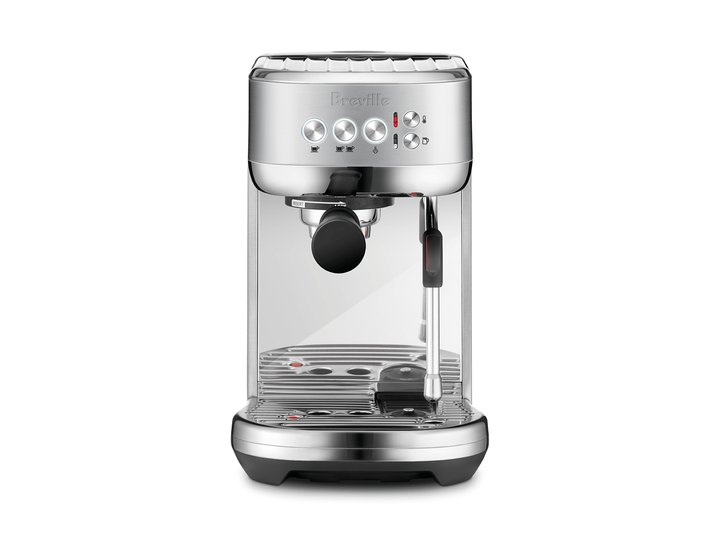
The Bambino with an automatic steam wand: three temperatures, three textures, an auto-purge, a bigger tank, a two-year warranty, and the tamper, Razor, jug and cleaning disc in the box.
Heater
ThermoJet, ready in 3 s
Temperature
PID
Pressure
15 bar pump; pre-infusion, 9 bar extraction
Baskets
54 mm; single wall and dual wall
Steam
Automatic, 3 temps × 3 textures; auto purge
Tank
64 fl oz
Size
11.9 × 7.4 × 14.3 in; 10.91 lb; 1,560 W
Warranty
2 years
Suits: The latte drinker who wants the milk done while they do something else.
Weigh: Automatic milk is less controllable than manual for latte art, though the wand can be run by hand. Same small tray. A bundle with the Encore ESP is a separate listing.
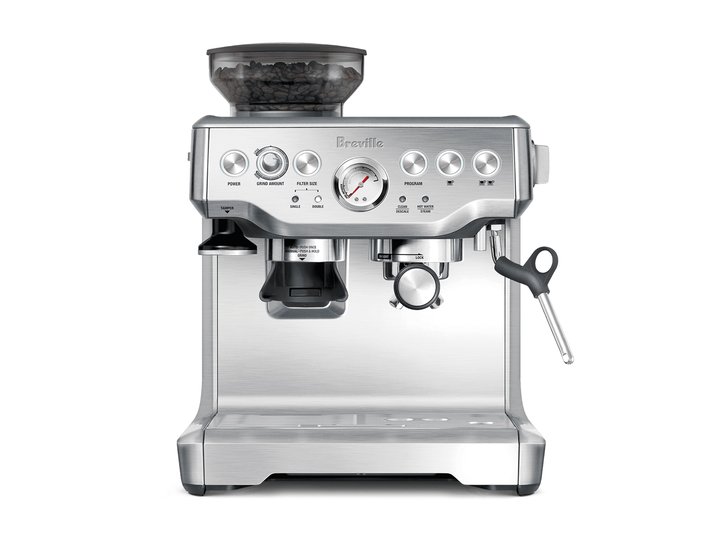
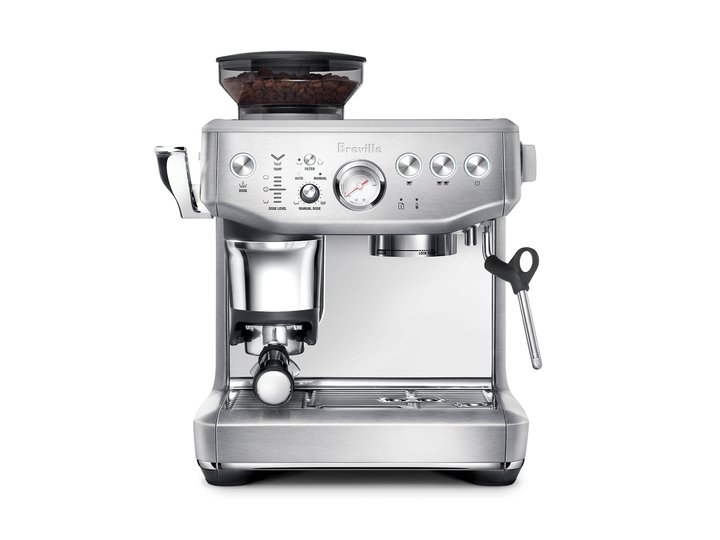
The one-box starter that put espresso in a million kitchens: a thermocoil with PID, a built-in conical grinder with 16 settings and a half-pound hopper, a pressure gauge, a manual wand and 54 mm baskets of both kinds.
Heater
1,600 W thermocoil, 200 °F
Temperature
PID
Pressure
15 bar pump; pre-infusion, 9 bar extraction; gauge
Grinder
Steel conical, 16 settings, ½ lb hopper
Baskets
54 mm; single wall and dual wall
Tank
67 oz
Size
15.9 × 13.1 × 12.4 in; 22.09 lb
Warranty
1 year
Suits: One purchase, one footprint, and a counter that has room for it.
Weigh: The built-in grinder is the weak link: coarse steps and retention, and you can't upgrade it without replacing the machine. One thermocoil means a wait between shot and steam. Heat-up time isn't published.
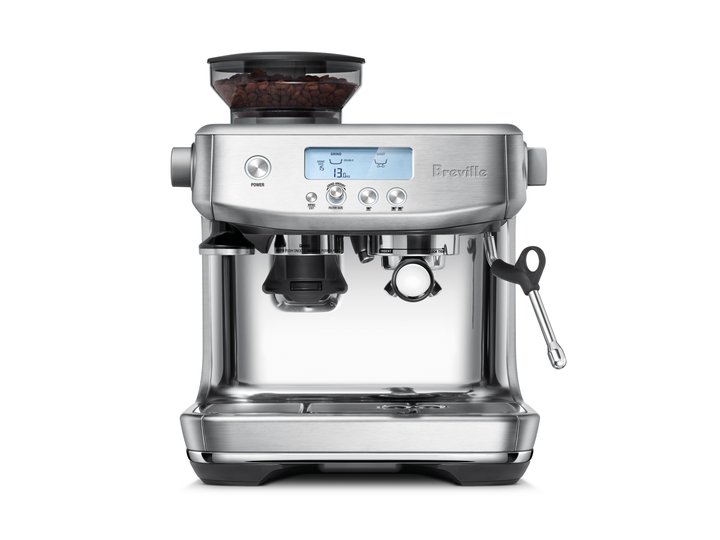
The Barista Express with the two beginner steps automated: a grinder that corrects the dose for the next shot and a lever that tamps at a constant 22 lb with a 7° twist, plus 25 grind settings and a two-year warranty.
Heater
1,750 W thermocoil
Temperature
PID
Pressure
15 bar pump; pre-infusion, 9 bar extraction; gauge
Grinder
Conical, 25 settings, 250 g hopper; Auto Dose Correct
Tamping
Assisted, constant 22 lb, 7° twist
Baskets
54 mm; single wall and dual wall
Tank
2 L
Size
16.6 × 14.4 × 12.2 in; 22.6 lb
Warranty
2 years
Suits: The beginner who wants dosing and tamping removed from the learning curve.
Weigh: The largest footprint here, and the grinder is still a basic conical. Amazon lists 23.7 lb; Breville says 22.6.
The lowest-cost machine here with a real manual steam wand: a stainless boiler, a 15 bar pump, two pressurized "crema" filters, a one-litre tank and a 90-second warm-up.
Heater
Stainless steel boiler; 90 s warm-up
Temperature
No PID
Pressure
15 bar pump
Baskets
2 pressurized (crema) filters
Steam
Manual wand
Tank
33.8 oz (1 L)
Size
13.5 × 8.07 × 11.22 in; 10.99 lb; 1,100 W
Warranty
1 year + 1 with registration
Suits: Finding out whether you like making espresso before buying a grinder.
Weigh: Pressurized baskets only, so it works with pre-ground and fakes the crema; no temperature control or gauge; a plastic body. Fine with a blade grinder, which is exactly its ceiling.
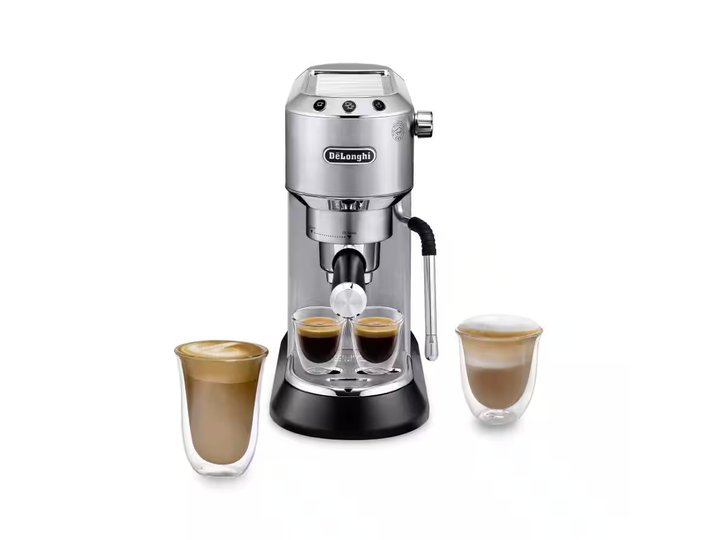
Thermoblock, 6 in wide, pressurized baskets, manual wand
De'Longhi Dedica Arte
De'Longhi EC885M
The Dedica with a proper wand: the six-inch-wide thermoblock machine, 15 bar pump, pressurized one- and two-cup baskets, a metal tamper in the box, and the "My LatteArt" steam wand in place of the old panarello.
Heater
Thermoblock
Temperature
No PID
Pressure
15 bar pump
Baskets
1 and 2 cup, pressurized; ESE pods
Steam
Manual "My LatteArt" wand
Tank
1.1 L
Size
149 × 330 × 305 mm; 5.9 kg; 1,300 W
Suits: The narrowest counter space in the aisle, and a latte drinker who wants to learn to steam.
Weigh: Pressurized baskets out of the box; a non-pressurized 51 mm basket is a third-party purchase, and De'Longhi doesn't publish the basket size. No PID. The US product page doesn't exist; specs are from De'Longhi's Australian page. Stock was thin on the check date.
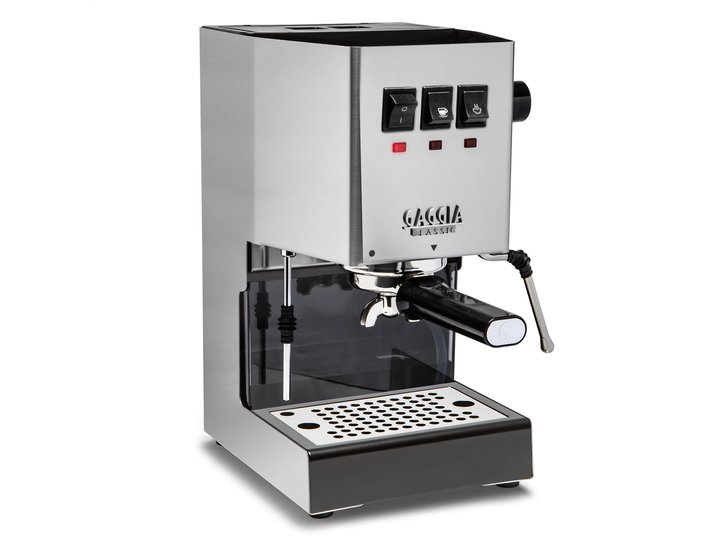
The 58 mm machine at an entry price: a brass single boiler (Gaggia specifies the brass contains no lead), an Italian Ulka pump with the over-pressure valve calibrated to 9 bar, a commercial-style two-hole steam wand, a three-way solenoid, and a 72 oz tank, in a steel box that has been modded for thirty years.
Heater
Single brass boiler, 3.5 oz
Temperature
No PID
Pressure
15 bar Ulka pump; OPV calibrated 9 bar
Baskets
58 mm stainless portafilter; 7–18 g baskets
Steam
Commercial-style 2-hole wand
Tank
72 oz
Size
14.2 × 8 × 9.5 in; 19 lb; 1,425 W
Suits: The buyer who wants the 58 mm standard, a machine that can be improved, and doesn't mind learning its temperature.
Weigh: No PID: you time the shot off the heating light ("temperature surfing") or add a kit. A small boiler means a pause before steaming. Amazon shows 1,900 and 1,200 W on one page; Gaggia says 1,425.
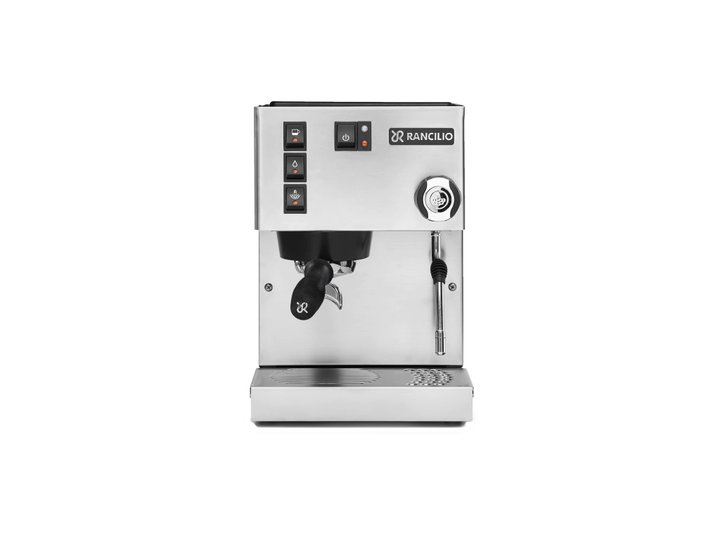
The home machine built like a café machine's group: a 0.3 L brass boiler, a vibration pump, a commercial portafilter that takes up to 21 g, a stainless steam wand and a 2 L tank, at 31 pounds.
Heater
Single brass boiler, 0.3 L
Temperature
No PID
Pressure
Vibration pump
Baskets
Portafilter to 21 g; 8 and 16 g baskets
Steam
Stainless wand
Tank
2 L
Size
235 × 340 × 290 mm; 14 kg; 950–1,000 W
Suits: The buyer who wants a machine that will still be working in twenty years and plans to add a PID.
Weigh: No PID from the factory, a single boiler so steam waits, and heavy. Rancilio doesn't state the portafilter diameter on its page (the listings say 58 mm). Stock was thin on the check date.
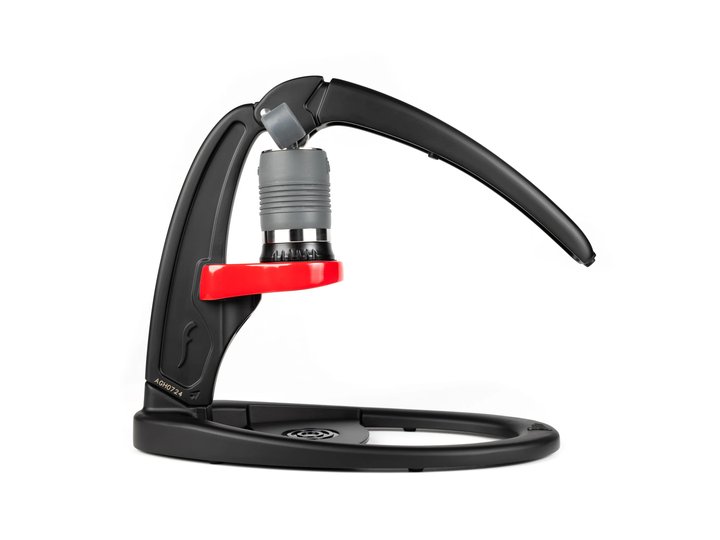
A lever press with no plug: you preheat the cylinder with kettle water, load 12–18 g, and pull the shot by hand against a gauge that shows the 9 bar zone. Cast aluminium and stainless, bottomless and flow-control portafilters in the box, three-year warranty.
Type
Manual lever
Dose
12–18 g; 60 ml brew water
Pressure
Integrated gauge, 9 bar zone
Basket
40 mm
Build
Cast aluminium, stainless; 14 × 10 × 4 in; 5 lb
Warranty
3 years, stand and brewing head
Suits: Full control of pressure and temperature for the cost of an entry machine, and a counter with no room for one.
Weigh: Every shot starts with the kettle and a preheat, and ends with a hot cylinder to rinse. Its 40 mm basket has its own tamper and accessory ecosystem. No steam; milk is a separate frother. Amazon lists a wattage for a device with no cord.
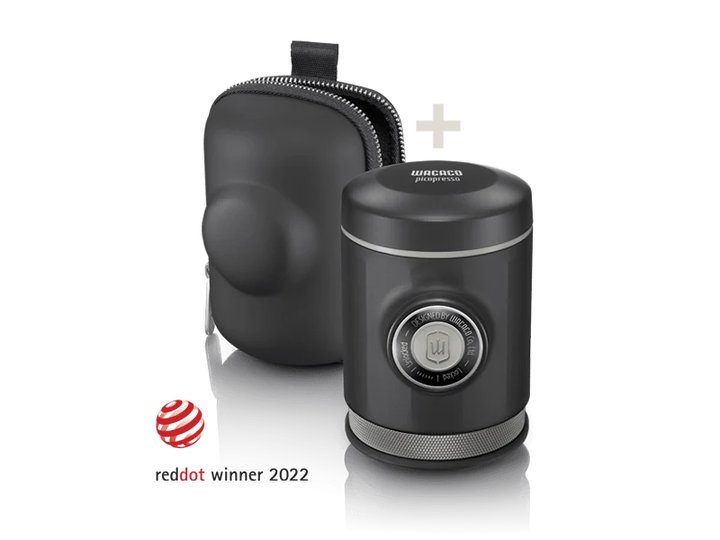
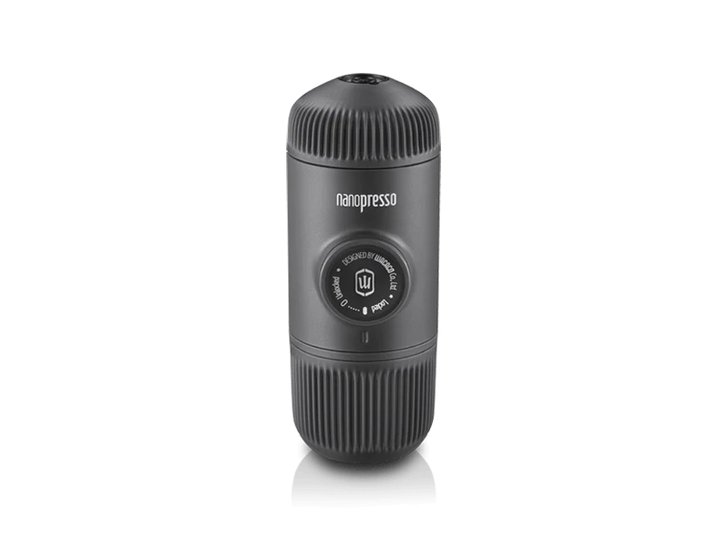
A palm-sized hand-pumped espresso maker with a real non-pressurized 52 mm basket, 18 g dose, 80 ml of water, and a tamper, distribution tool and funnel in the case: café-grade shots from a backpack.
Type
Hand pump; up to 18 bar
Basket
52 mm, 18 g, non-pressurized
Water
80 ml
Size
71 × 78 × 106 mm; 350 g
In the box
Tamper, distribution tool, funnel, case
Warranty
2 years
Suits: Travel, the office, camping, with a hand grinder and a kettle.
Weigh: Needs a capable grinder and hot water from somewhere; one small shot per cycle. Several bundles with stands and grinders are separate listings.
Every box says 15 bar, and every good shot is pulled at about 9. The pump\'s rating is what it can do; a valve limits what reaches the coffee. Breville states low-pressure pre-infusion then 9 bar extraction on every machine here; Gaggia calibrates its over-pressure valve to 9 bar; De'Longhi lists the pump and nothing else. A bigger number on the box means nothing about the espresso.
The other number that matters is the basket: 54 mm on every Breville, 58 mm on the Gaggia (and, by every listing, the Silvia), 51 mm on the De'Longhis by third-party measure. Tampers, funnels, bottomless portafilters and upgrade baskets are bought to that size, so it decides your accessory ecosystem for years. The tools page is sorted by it.