Product links on this page go to Amazon. If you buy through them, Your First Espresso earns a commission. How we pick and earn
The most common first setup is a good machine and a bad grinder, and the result is a hundred sour, bitter shots and a machine for sale on a classifieds site. Here is why, and what to buy instead.
What espresso asks of a grinder
Drip coffee steeps for minutes through a coarse grind; a few big and small particles don’t matter. Espresso forces water through a packed puck at nine bar for 25 to 30 seconds. The water takes the path of least resistance, so where the grind is coarse or uneven it rushes through and extracts little, and where it’s fine it over-extracts. One shot tastes sour and bitter at the same time. The fix is a grind that is both fine enough and uniform, and that is a grinder property, not a machine property.
Fellow’s beginner guide: a quality grinder is “arguably the most important part of your espresso setup. Essential for achieving the fine, highly consistent grind size that espresso requires.”
Burrs, never blades
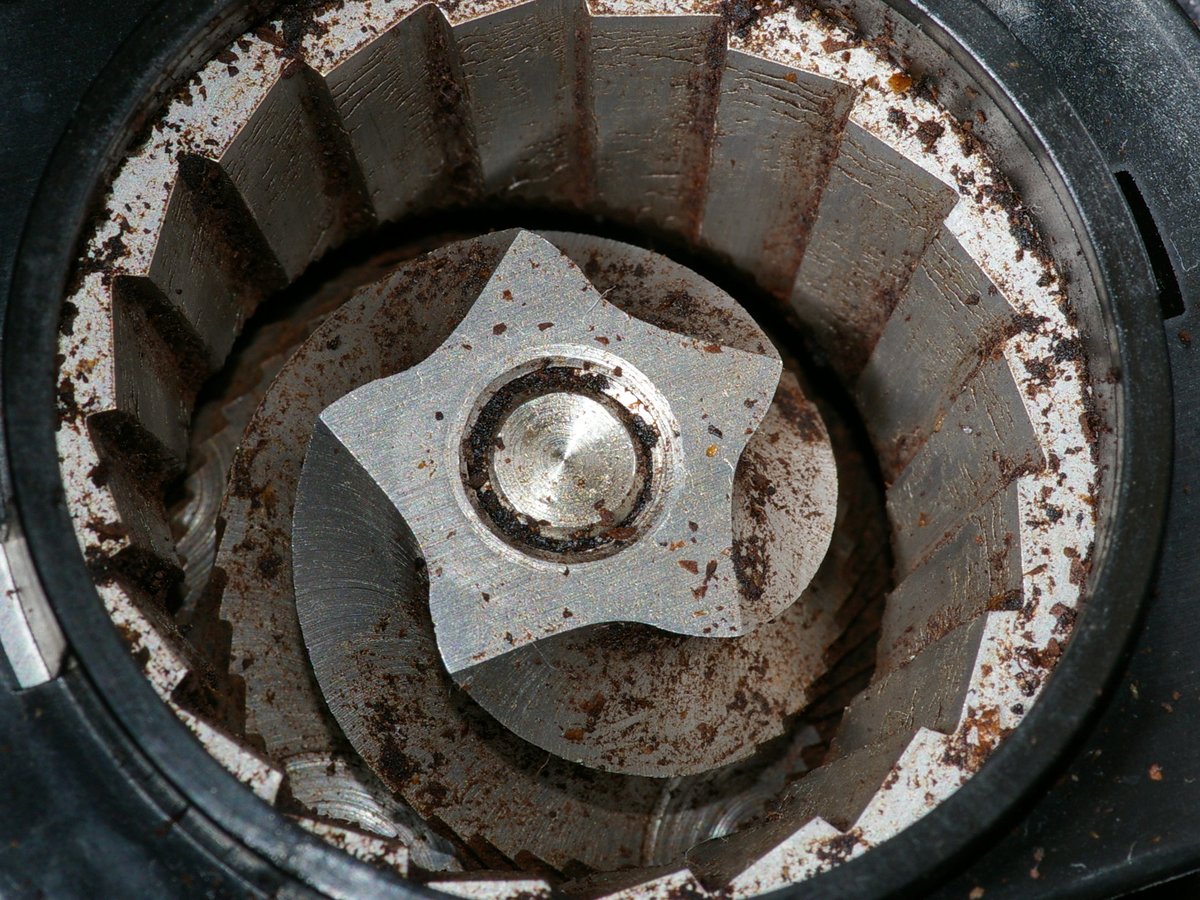
A blade grinder chops at random: dust and boulders in the same batch. A burr grinder crushes beans between two cutting surfaces set a fixed gap apart, so the particles come out close to one size. Breville, which sells both kinds, says burrs “produce a more consistent grind size, allowing for a more balanced extraction”. For espresso the blade grinder isn’t a lesser option; it is not an option.
Conical or flat, and size
Conical burrs are compact, quiet, forgiving and cheaper to make; nearly every entry grinder uses them. Flat burrs grind faster and more uniformly and are what café grinders use. Bigger burrs grind faster and run cooler: 40 mm conicals in the Encore ESP, 48 in the Opus and the J-Ultra, 55 mm flats in the Eureka, 64 in the DF64. A good 48 mm hand grinder outgrinds a cheap 40 mm electric one; the hand is the motor.
Electric, 55 mm flat, stepless, timed
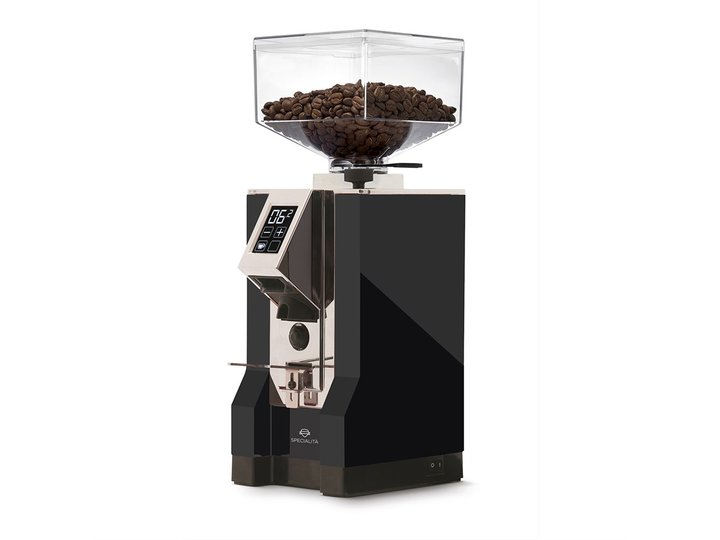
Eureka Mignon Specialità
Eureka Mignon Specialità
The Italian espresso grinder the hobby settled on: 55 mm flat burrs, a stepless micrometric dial, a touch display with two timed doses, a quiet motor, and a build that outlasts several machines.
- Burrs
- 55 mm flat, hardened steel
- Adjustment
- Stepless micrometric
- Dosing
- Touch display, 2 timed doses + continuous
- Speed
- 1,350 rpm; 1.8–2.5 g/s
- Power
- 310 W
- Size
- 350 × 120 × 140 mm; 5.6 kg; 300 g hopper
Suits: The grinder you buy once. Anyone pulling two or more shots a day.
Weigh: Hopper-fed, so some grounds stay in the chute between doses; the adjustment ring is at the bottom of the burr set. Amazon's 550 W and 14.6 lb are wrong; Eureka says 310 W and 5.6 kg.
Stepped or stepless
Espresso lives in a narrow band of fineness, and a shot that runs in 20 seconds at one setting may run in 35 at the next. Stepless dials (Eureka, Opus, DF64) land anywhere in between. Stepped dials with 40 or 60 positions (Encore ESP, Smart Grinder Pro) sometimes have the right shot between two clicks, and you adjust dose instead. Hand grinders with fine clicks (8 or 16 microns) behave like stepless.
Hopper or single-dose
A hopper grinder holds a bag of beans and grinds by time; the next shot’s grounds are partly yesterday’s, left in the chute. A single-dose grinder (Opus, DF64, the hand grinders) takes one weighed dose and clears itself with bellows: fresher and exact, at the cost of weighing each time. For a beginner, weighing in is a feature: it’s the first half of the recipe.
Electric, 64 mm flat, stepless, single-dose
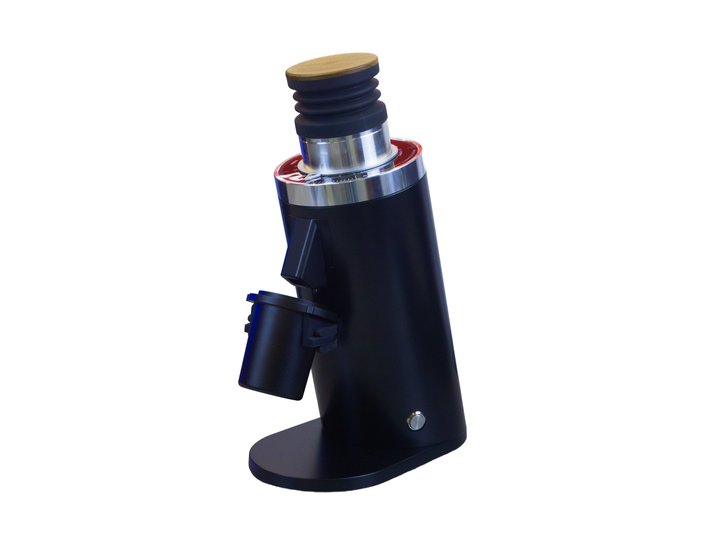
DF64 Gen 2
DF64 DF64 Gen 2
Sixty-four millimetre flat burrs, stepless, single-dose with bellows, at a price that used to buy 40 mm conicals: the grinder that moved the home-espresso goalposts, with upgrade burrs available later.
- Burrs
- 64 mm stainless flat (SSP/DLC options)
- Adjustment
- Stepless
- Dose
- Single-dose, bellows, 50 g
- Power
- 250 W, 100–120 V
- Size
- 22.5 × 13 × 30 cm; 7.2 kg
- Warranty
- 1 year
Suits: The espresso-first buyer who wants flat-burr clarity and will weigh every dose.
Weigh: Sold under several importer names on Amazon (DF64, Turin, MiiCoffee), so check the listing says Gen 2. Unit-to-unit alignment varies; the one-year warranty is standard.
The two mistakes
Spending the whole budget on the machine. A Bambino with an Encore ESP pulls better shots than a one-box machine at three times the price fed by its built-in grinder. Split the money.
Buying a grinder that “does espresso” in the marketing but not on the spec sheet. Fellow’s Ode doesn’t; the Opus does. Baratza’s plain Encore doesn’t; the ESP does, with a dial made for it. Kingrinder’s own comparison prefers its K4 for espresso over the K6. Read the maker’s words, which is what the grinders page quotes.
Which one
- First grinder, Breville or Gaggia budget: Encore ESP.
- Espresso and filter from one machine: Fellow Opus 2.
- Buy once: Eureka Specialità, or the DF64 for flat burrs and single dosing.
- No counter space: 1Zpresso J-Ultra.
Then the machine: which setup.