Product links on this page go to Amazon. If you buy through them, Your First Espresso earns a commission. How we pick and earn
Home espresso is bought backwards by almost everyone: the machine first, the grinder as an afterthought. Here is the order that works and the words on the box, then a setup for each way people drink.
Two questions
- How do you drink it? Straight shots and Americanos need a machine that holds temperature and a grinder that reaches espresso fine. Lattes add a steam wand worth using, or an automatic one. Both need the same grinder.
- What will you spend on the pair? Half of it goes to the grinder. A setup where the machine costs three times the grinder is a machine waiting for a grinder.
The grinder comes first
Espresso forces hot water through finely ground coffee at about nine bar. If the grind is uneven, water finds the easy paths, over-extracts there and under-extracts everywhere else, and the shot is sour and bitter at once. Fellow’s beginner guide calls the grinder “arguably the most important part of your espresso setup”, and Breville’s own page says burrs give “a more consistent grind size, allowing for a more balanced extraction”. A blade grinder cannot make espresso. The grinder guide has the details; the short version is: burrs, fine enough, adjustable in small steps.
Electric, 40 mm conical, stepped
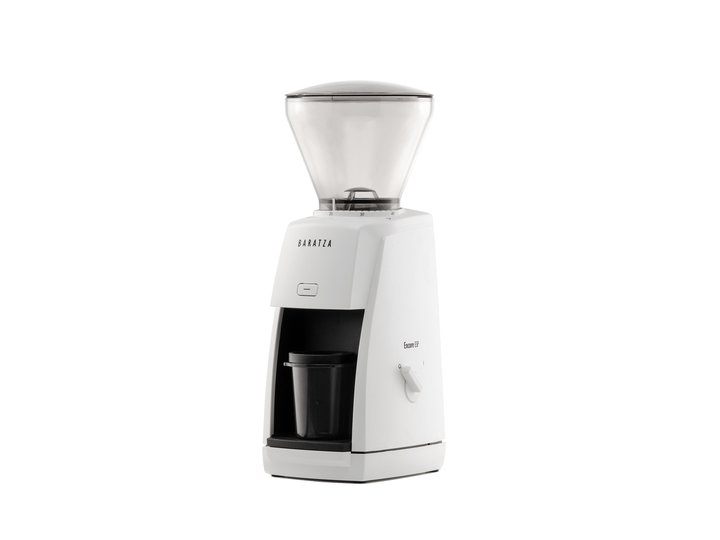
Baratza Encore ESP
Baratza Encore ESP
The entry espresso grinder: Baratza's Encore with a finer first half of its dial, settings 1–20 for espresso and 21–40 for filter, a dosing cup in the box, and the maker's own words that it grinds "creamy, syrupy shots".
- Burrs
- 40 mm conical steel (M2)
- Adjustment
- 40 steps; 1–20 espresso range
- Hopper
- 300 g; dosing cup included
- Speed
- 550 rpm; 1.3–2.2 g/s
- Power
- 70 W, 100–120 V; UL/CSA listed
- Size
- 13 × 15 × 34 cm
- Warranty
- 1 year
Suits: The first grinder for a Bambino, Dedica or Gaggia; the one that makes a non-pressurized basket possible.
Weigh: Slow (1.3–2.2 g/s), plastic body, static on the cup. Stepped, so a shot that needs a half-step is a dose change instead. Baratza doesn't publish the weight.
The words on the machine
Thermoblock, ThermoJet, thermocoil, boiler. The first three heat water as it passes: ready in seconds (Breville says three), light, and steady when paired with a PID. A boiler holds a reservoir of hot water: slower to heat, stronger steam, the design that takes a PID well and lasts decades. Entry machines are the first kind; the Gaggia and Rancilio are the second.
PID. A controller that holds the brew water at a set temperature; Breville claims ±2 °C. Without one, you wait for a light and time the shot off it. All five Brevilles here have one; the De’Longhis, Gaggia and Silvia don’t.
15 bar. The pump’s rating, on every box. The shot is pulled at about 9; Breville states “low pressure pre-infusion followed by 9 bar extraction”, Gaggia calibrates its valve to 9 bar. The number on the box tells you nothing.
54 mm, 58 mm. The basket diameter, which decides every tamper, funnel and portafilter you buy afterwards. Breville is 54 mm; Gaggia is 58 mm; De’Longhi doesn’t say (51 mm by third-party measure).
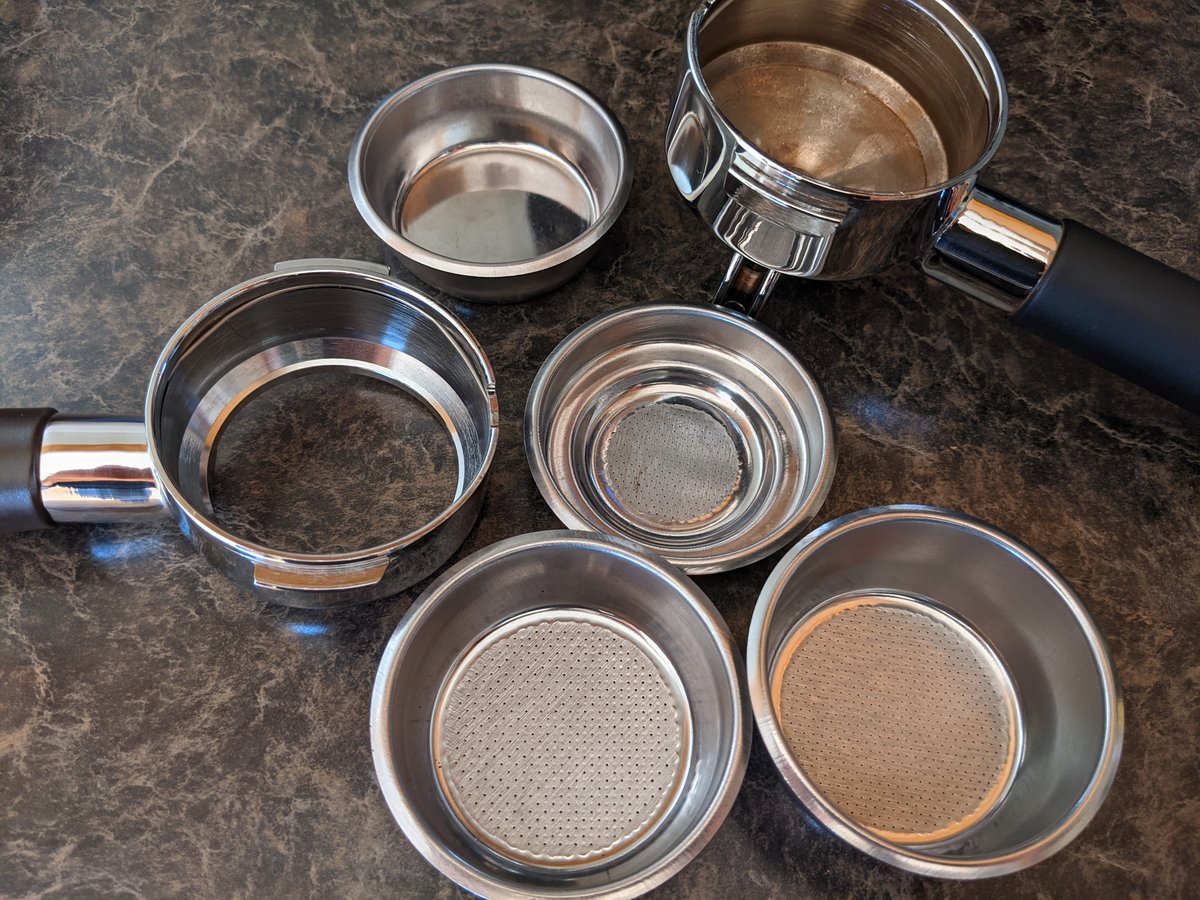
Single wall, dual wall. Non-pressurized and pressurized baskets. Breville’s manual: single wall for fresh beans, where you control grind, dose and tamp; dual wall for pre-ground or old beans, where the basket “regulate[s] the pressure” regardless. Real espresso is single wall. The basket guide explains.
Six situations
| You | Grinder | Machine |
|---|---|---|
| Real espresso, willing to learn | Encore ESP | Bambino |
| Lattes, no steaming lessons | Encore ESP | Bambino Plus |
| One box | built in | Barista Express or Impress |
| The ten-year machine | Eureka Specialità | Gaggia Classic Evo Pro |
| No counter, no plug | 1Zpresso J-Ultra | Flair Classic or Picopresso |
| Just trying it | pre-ground for now | Stilosa |
Thermojet, PID, manual steam, 54 mm
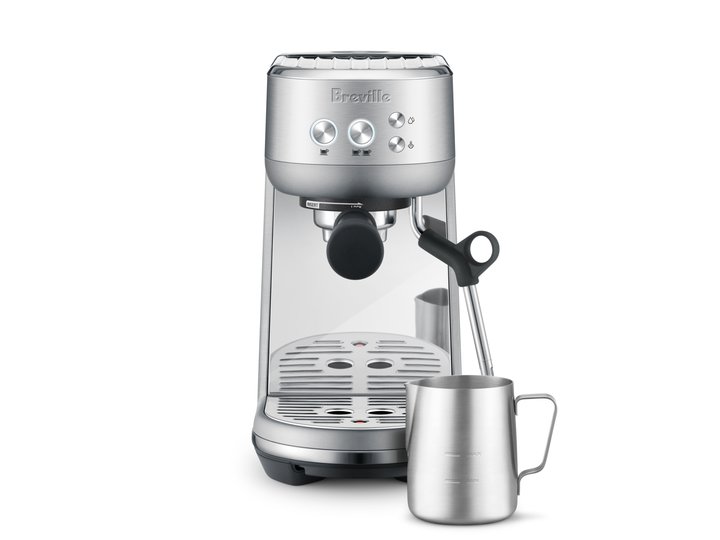
Breville Bambino
Breville BES450
The small machine that changed the entry level: hot in three seconds, PID temperature control, low-pressure pre-infusion then 9 bar, single-wall and dual-wall 54 mm baskets in the box, and a manual steam wand that makes real microfoam.
- Heater
- ThermoJet, ready in 3 s
- Temperature
- PID
- Pressure
- 15 bar pump; low-pressure pre-infusion, 9 bar extraction
- Baskets
- 54 mm; 1 and 2 cup, single wall and dual wall
- Steam
- Manual wand
- Tank
- 47 fl oz
- Size
- 11.9 × 6.1 × 13.5 in; 10.42 lb; 1,560 W
- Warranty
- 1 year
Suits: A small kitchen and a separate grinder. The machine most of this site assumes.
Weigh: Light, plastic-bodied, a tiny drip tray and no pressure gauge. No grinder; that is the point, and the budget.
Then
A scale and a tamper from the tools page, and the first shot: 18 g in, 36 g out, 25 to 30 seconds.